
Wild & Weird in North Central Kansas: 10 Stops Worth the Road Trip
North Central Kansas has never been particularly interested in being ordinary.
This is a place where Wild Bill Hickok once walked the streets, Pony Express riders raced across the frontier, bison still roam the prairie, a ball of twine just keeps getting bigger, and an entire town has made weird an art form.
So hit the road. North Central Kansas is about to get wild and weird.
Ready for a road trip? We're starting in Abilene, heading east into the Flint Hills, turning north toward the Nebraska line, then working our way west before looping back through some of Kansas' quirkiest communities and ending in Salina.
Along the way, we'll find cowboys, bison, Pony Express riders, unexpected history, giant twine, giant eggs, giant bathrooms and a few things that are almost impossible to explain.
Let's get wild and weird!
1. Abilene | Where the Wild West Was Really Wild
 We're starting where things were once legitimately wild.
In the late 1860s and early 1870s, Abilene became the first Kansas cowtown at the end of the Chisholm Trail. Hundreds of thousands of Texas longhorns arrived here, along with cowboys ready to spend their pay after months on the trail.
The result? A wild and woolly town filled with saloons, gambling and plenty of characters. Wild Bill Hickok served as marshal, and Abilene earned its place among the legendary towns of the Old West.
Today, visitors can explore that story at Old Abilene Town, discover the Chisholm Trail and learn more about the lawmen, cowboys and cattle that put Abilene on the map.
But we promised weird, too.
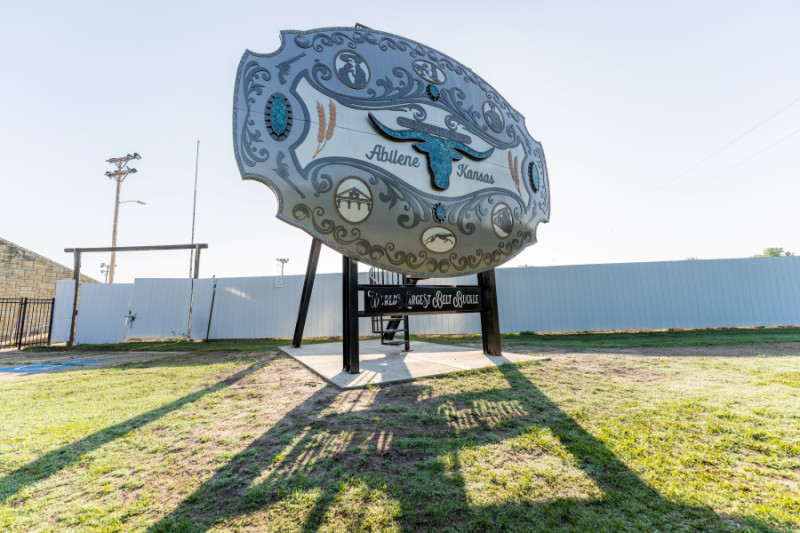
Meet the World's Largest Belt Buckle.
This giant tribute to Abilene's cowboy heritage is exactly the kind of roadside attraction that requires a photo. And while you're in town, look for the Big Spur and the World's Largest "I Like Ike" Button for a few more only-in-Abilene photo ops.
Don't miss: World's Largest Belt Buckle, Old Abilene Town and Abilene's Chisholm Trail history.
2. Manhattan | Where the Wild Things Roam
From Wild West history, we're heading east for a different kind of wild.
Just outside Manhattan, Konza Prairie Biological Station protects thousands of acres of native tallgrass prairie in the Flint Hills.
Hiking trails take visitors into a landscape of rolling hills, tallgrass and seemingly endless Kansas sky. Keep your eyes open for wildlife along the way.
Konza is also home to a research bison herd, a reminder of the enormous herds that once roamed the Great Plains.
No giant roadside attraction required here. Sometimes Kansas is plenty wild all on its own.
Don't miss: Hiking the Konza Prairie trails and those incredible Flint Hills views.
3. Marysville | The Wild Ride West and Some Weird Squirrels
Now we're turning north for a story involving horses, speed and one very ambitious mail route!
For just 18 months in 1860 and 1861, Pony Express riders carried mail nearly 2,000 miles between Missouri and California.
Marysville was right in the middle of the action.
Today, the Pony Express Barn & Museum preserves the original Home Station No. 1 and tells the story of the riders, horses and logistics behind one of the most famous chapters of the American frontier.
Imagine climbing onto a horse with a bag full of important mail and knowing hundreds of miles of open country stood between you and your destination.
That's wild!
Looking for the weird? Keep an eye out for Marysville's famous black squirrels. These unusual residents have become such a part of the community's identity that Marysville is known as Black Squirrel City. You'll find the real thing scampering around town, along with colorful larger-than-life squirrel statues as part of the Black Squirrels on Parade public art project.
Don't miss: The original Pony Express Home Station No. 1 and keep your camera ready for a black squirrel sighting!
4. Concordia | History You Didn't Expect
Some of the best road-trip stops are the ones that make you say, "I had no idea that happened here."
Concordia has more than one.
The National Orphan Train Complex tells the story of the Orphan Train Movement, which relocated children from crowded Eastern cities to communities across the United States from the 1850s into the early 20th century. The museum preserves the stories of the children and families whose lives were forever changed by the movement.
Then there's Camp Concordia.
During World War II, thousands of German prisoners of war were housed at a POW camp just outside Concordia. Today, visitors can learn about this unexpected piece of Kansas and World War II history.
Neither story is "weird" in the giant-ball-of-twine sense. They're something even better for a road trip: completely unexpected!
Don't miss: National Orphan Train Complex and the story of Camp Concordia.
5. Lebanon | Stand in the Middle of America
 You've gone this far north. You might as well stand in the middle of the country.
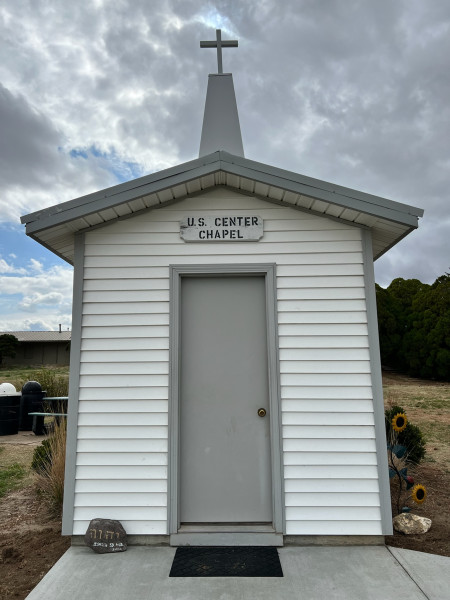
Near Lebanon, a monument marks the Geographic Center of the Contiguous United States.
It's one of those wonderfully simple roadside stops that makes a great story later: "Oh, yeah. I've stood in the middle of America."
You'll find the marker, wide-open Kansas scenery and a tiny chapel nearby.
Take the picture. Sign the guestbook. Enjoy the fact that for at least a few minutes, you're right in the middle of it all.
Don't miss: The photo proving you made it to the middle of the Lower 48.
6. Cawker City | That's a LOT of Twine
 Somebody had to do it.
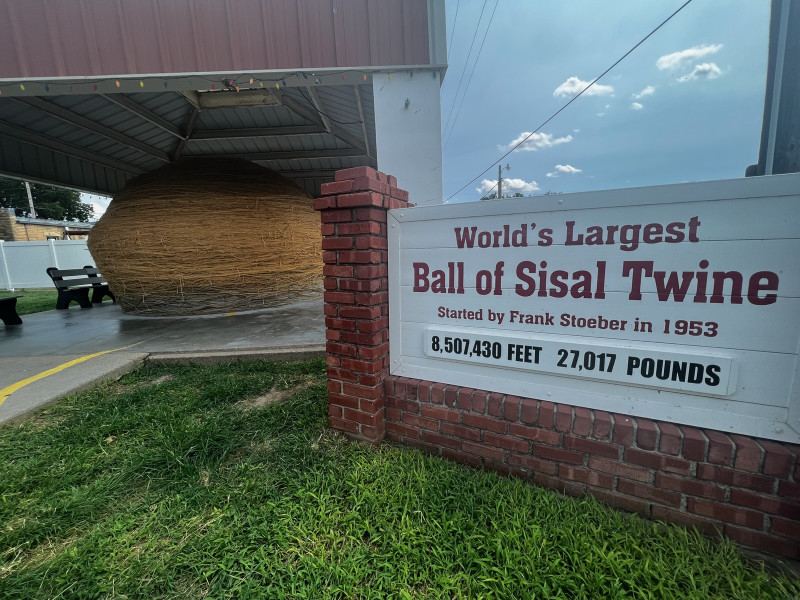
In 1953, Cawker City farmer Frank Stoeber began rolling leftover pieces of sisal twine into a ball.
And then he kept going.
Today, Cawker City's World's Largest Ball of Twine is a classic Kansas roadside attraction, and unlike most "world's largest" things, this one is still growing.
The community has continued adding twine over the years, and visitors come from around the world to see the enormous result.
Because apparently once you have a giant ball of twine, the logical next step is to make it even bigger.
Don't miss: A photo with the twine. Obviously.
7. Lucas | Where Weird Is Wonderful
 We're not choosing one attraction in Lucas.
We can't.
The whole town gets this spot.
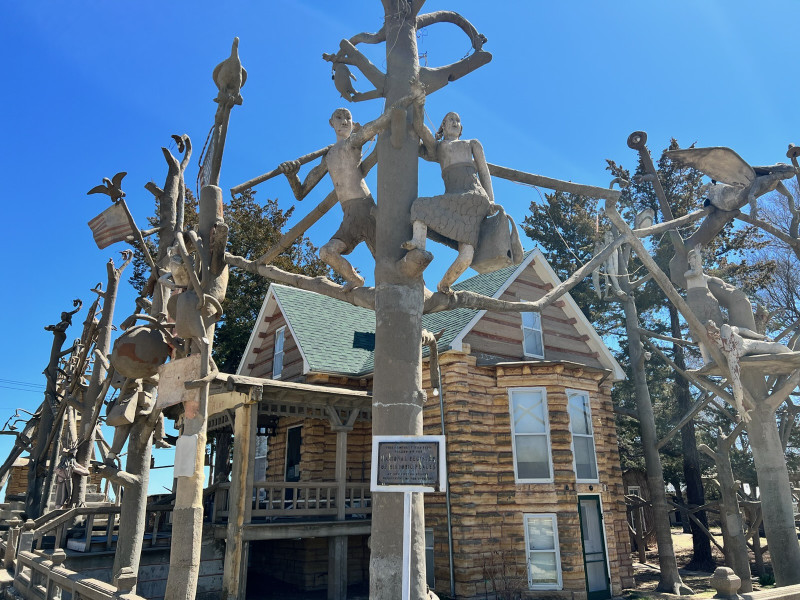
Start with S.P. Dinsmoor's Garden of Eden, where concrete sculptures created more than a century ago surround a historic log cabin.
Then find the World's Largest Collection of the World's Smallest Versions of the World's Largest Things.
Yes, you read that correctly.
There's also the Grassroots Art Center, colorful public art and Bowl Plaza, perhaps the most famous public restroom in Kansas. The giant toilet-themed building is covered in elaborate mosaics and has become a tourist attraction all its own.
Lucas doesn't just tolerate weird.
Lucas celebrates it.
And that's exactly why you need to go.
Don't miss: Garden of Eden, Bowl Plaza and the World's Largest Collection of the World's Smallest Versions of the World's Largest Things.
8. Wilson | One Really Big Egg
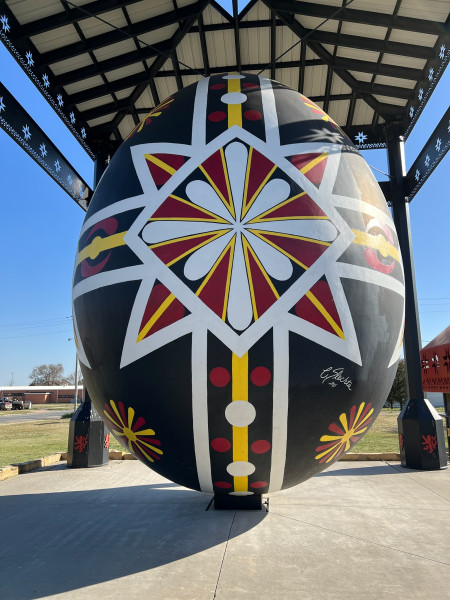 From one wonderfully unusual community, we're heading to another with a roadside attraction that's hard to miss.
Welcome to Wilson and the World's Largest Czech Egg.
The enormous hand-painted egg celebrates the community's Czech heritage with traditional designs on a decidedly nontraditional scale.
It's colorful. It's enormous. It's wonderfully specific. You simply must, "Czech it out!"
In other words, it's exactly what a Wild & Weird road trip needs.
Take the photo, then spend a little time exploring Wilson and discovering the Czech heritage that inspired it.
Don't miss: Standing next to the egg for scale.
9. Minneapolis | Did Nature Really Make Those?
 By this point, you may think Kansans are responsible for all the weirdness on this trip.
Not so fast.
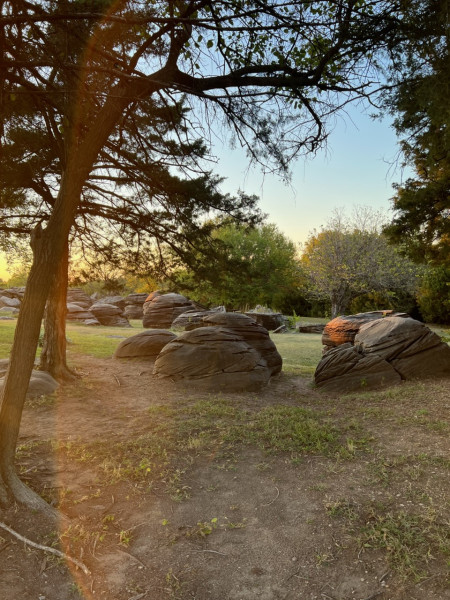
Nature gets a turn at Rock City near Minneapolis!
Scattered across the landscape are hundreds of enormous sandstone concretions, some several yards across. Their unusually round shapes can look more like giant stone marbles than naturally occurring geological formations.
But nature really did make them.
Walk among the formations, take pictures and enjoy one of those Kansas landscapes that looks nothing like what people expect Kansas to look like.
Tip: Hungry? Thirsty? Need a pickleball break? Check out The Farm!
Don't miss: Exploring among the giant sandstone formations.
10. Salina | Take a Walk on the Wild Side
We're ending our Wild & Weird road trip with something truly wild at Rolling Hills Zoo!
Among the zoo's 100+ species are southern white rhinos, one of the largest land mammals on Earth. And here's the weird part: white rhinos aren't actually white. They're gray!
Even better, Rolling Hills Zoo welcomed a southern white rhino calf in 2026. His name? Creed, named after Kansas City Chiefs center Creed Humphrey.
Don't miss: The white rhinos. They're wild, they're gray, and they're a pretty great way to end this road trip.
We started with Kansas' Wild West.
We're ending with the wild kingdom!
Ready to Get Wild & Weird?
The best road trips aren't always about getting from Point A to Point B as quickly as possible.
Sometimes they're about pulling over because you spotted something strange.
They're about discovering a story you never learned in school, standing next to something ridiculously oversized, exploring a landscape that doesn't seem possible and finding the wonderfully unexpected in places you might otherwise drive right past. That's North Central Kansas!
So take the backroads. Make the stop. Take the picture. Read the historical marker.
And when you see a sign promising the World's Largest anything?
You should probably turn.
There's always something wild, weird or wonderfully unexpected waiting just down the road in North Central Kansas!
Request a free copy of the Kansas Travel Guide